|
Origin
These fascinating genera of succulents belong to the orpine family or stronecrop family (Crassulaceae) and are mainly endemic to the Canary islands, Spain. Few species only are found on Madeira (Aeonium glandulosum, respectively Aeonium glutinosum), in Eritrea and Ethiopia, East Africa (Aeonium stuessyi,
respectively Aeonium leucoblepharum), in the Anti-Atlas mountain range in
south-western Morocco (Aeonium arboreum = syn. Aeonium korneliuslemsii, as well as a couple of little know Aichryson species) and last but not least on the Cape Verde islands (only Aeonium gorgoneum).
The Genus Aeonium
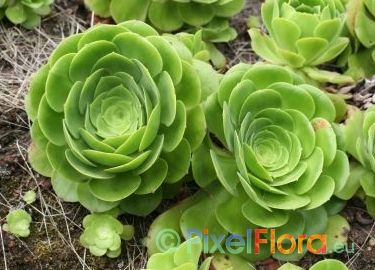 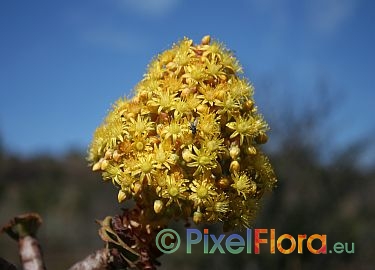 At least for the genus Aeonium it is supposed that all taxa derive from a single Prototype "Aeonium" which had been growing some 19 million years ago in the former area of the "Thetys" ocean (which is now the Mediterranean area) and of which some seeds incidentally arrived at the Canary Islands, raising from the Atlantic Ocean in that era. Due to drastic climatic changes over the past 15 million years in that area, in which for example the great Sahara desert in North Africa
had developed, the prototype vanished and left a disjunctional gap between populations in
eastern Africa and the Canary islands, which had completely been separated by the desert. Because of rather unfavorable climatic conditions in eastern Africa only two new species were able to develop in this area (Aeonium stuessyi and Aeonium leucoblepharum), whereas on the Canary islands some astonishing 40 taxa arose in a process of evolutionary radiation and vicariation. At least for the genus Aeonium it is supposed that all taxa derive from a single Prototype "Aeonium" which had been growing some 19 million years ago in the former area of the "Thetys" ocean (which is now the Mediterranean area) and of which some seeds incidentally arrived at the Canary Islands, raising from the Atlantic Ocean in that era. Due to drastic climatic changes over the past 15 million years in that area, in which for example the great Sahara desert in North Africa
had developed, the prototype vanished and left a disjunctional gap between populations in
eastern Africa and the Canary islands, which had completely been separated by the desert. Because of rather unfavorable climatic conditions in eastern Africa only two new species were able to develop in this area (Aeonium stuessyi and Aeonium leucoblepharum), whereas on the Canary islands some astonishing 40 taxa arose in a process of evolutionary radiation and vicariation.
Aeonium populations in south-western Morocco and on the Cape Verde archipelago most likely derive from Canarian ancestors, whereas the decency of Aeonium glutinosum and Aeonium glandulosum on Madeira is still questionable, as it seems that Aeonium nobile (endemic to la Palma, Canary islands) derives from Aeonium glutinosum. At present some 39 valid taxa have been described and for a couple of recent discoveries in the last years a valid description is pending. The provisional names of the latter species bear a suffix like "sp. nov. ined.",
"ssp. nov. ined." or "var. nov. ined." in our listings.
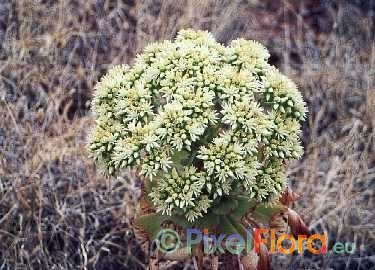 Tenerife shows the highest diversity in the genus
Aeonium, with some 12 species, out of which 10 are endemic to this island. The abundance of endemic species is most likely a result of the enormous geological and climatic niches on this island. Each species of Aeonium is perfectly adapted to its more or less restricted habitat. Some species appear in the lower xerophytic zone (succulent shrub), which starts only few meters above sea-level, such as Aeonium lindleyi in the
north-eastern part of the Anaga Mountain range on Tenerife, Aeonium percaneum in open lava formations on the eastern part of Gran Canaria and Aeonium lancerottense as its counter-part on Lanzarote. Tenerife shows the highest diversity in the genus
Aeonium, with some 12 species, out of which 10 are endemic to this island. The abundance of endemic species is most likely a result of the enormous geological and climatic niches on this island. Each species of Aeonium is perfectly adapted to its more or less restricted habitat. Some species appear in the lower xerophytic zone (succulent shrub), which starts only few meters above sea-level, such as Aeonium lindleyi in the
north-eastern part of the Anaga Mountain range on Tenerife, Aeonium percaneum in open lava formations on the eastern part of Gran Canaria and Aeonium lancerottense as its counter-part on Lanzarote.
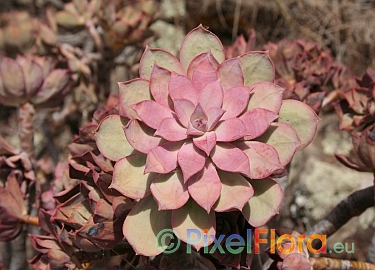 However the majority of Aeonium species prefer a more balanced and semi-humid climate on north-facing sides of all western islands (La Palma, El Hierro, La Gomera and Tenerife)
as well as on Gran Canaria, at some hundred
meter above sea-level. The tropical trade winds from the North have to climb up the central mountain ranges, which are between some 800m to almost 2.000 m in height. The winds cool down results in a condensation of humidity. Under these conditions, yet in separated habitats, most Aeonium species occur. Two species with rather untypical habitats grow on Tenerife: Aeonium smithii in the subalpine zone of the Cañadas depression and the "Valle de Ucanca" (Ucanca Valley) in the southern part of the Cañadas at some 2.100 m above sea level and on the other hand Aeonium cuneatum from quite the contrary environment, namely the evergreen and rather humid laurel forest
in both, the eastern and the western part of Tenerife. However the majority of Aeonium species prefer a more balanced and semi-humid climate on north-facing sides of all western islands (La Palma, El Hierro, La Gomera and Tenerife)
as well as on Gran Canaria, at some hundred
meter above sea-level. The tropical trade winds from the North have to climb up the central mountain ranges, which are between some 800m to almost 2.000 m in height. The winds cool down results in a condensation of humidity. Under these conditions, yet in separated habitats, most Aeonium species occur. Two species with rather untypical habitats grow on Tenerife: Aeonium smithii in the subalpine zone of the Cañadas depression and the "Valle de Ucanca" (Ucanca Valley) in the southern part of the Cañadas at some 2.100 m above sea level and on the other hand Aeonium cuneatum from quite the contrary environment, namely the evergreen and rather humid laurel forest
in both, the eastern and the western part of Tenerife.
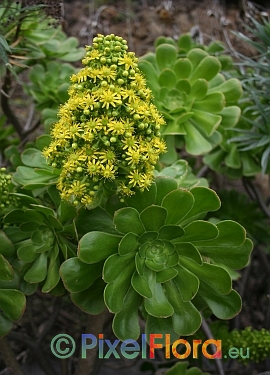
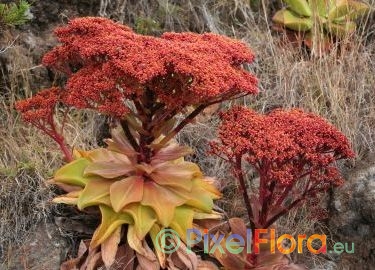
All Aeonium species either grow as perennials or small, semi-woody shrubs. Aeonium hierrense (El Hierro) and Aeonium urbicum and Aeonium urbicum ssp. meriodonalis (both from Tenerife), Aeonium appendiculatum (La Gomera), as well as Aeonium nobile (La Palma) and Aeonium tabuliforme (Tenerife) flower only one time in their life. After that they slowly die down, leaving millions of dust like seeds
for the next generation. In all other species the flowering rosette will die down as well, however, it will make new offsets below so that plants keep on growing vegetatively.
  What you might find at your local garden store offered as "Aeonium" has seldom anything to do with the real species. You might be very disappointed to know that those plants usually are hybrids and cultivars of little botanical value, and will hardly survive in your cultivation, except for the commonly offered Aeonium arboreum "Zwartkop", which is a
selected cultivar. Most specimens of Aeonium "Atropurpureum" are degenerated due to excessive ongoing hybridization. However this plant definitely does not descend from the real species Aeonium arboreum (now botanically corrected to Aeonium korneliuslemsii).
The real species Aeonium arboreum is found at only very few sites in coastal mountains of the south-western Morocco and does not occur on the Canaries, nor is it offered at any nursery specialized in succulents in the world. If you haven't seen the vigor and beauty of a real Aeonium arboreum flowering, then you might think Aeonium "Zwartkop"
is an ornamental species. What makes a correct identifcation and species'
seggregation even worse is that numerous old, invalid synonyms (such as Aeonium pseudotabuliforme) or even "fantasy" names are still in use in order to have a very broad offer. Private enthusiasts, who would like to build up a botanical collection, might become frustrated when they realize that what they grow is of little horticultural value. Furthermore, all Aeonium species from the Canaries easily hybridize,
and even intergeneric hybrids between Aeonium and Greenovia do naturally occur (= x Greenonium). So what you might be sold as for example Aeonium holochrysum rarely does represent a true-to-type plant. All our seeds are from true-to-type specimens. When you buy seeds from us, you
will be sure to get the species you would like to grow! What you might find at your local garden store offered as "Aeonium" has seldom anything to do with the real species. You might be very disappointed to know that those plants usually are hybrids and cultivars of little botanical value, and will hardly survive in your cultivation, except for the commonly offered Aeonium arboreum "Zwartkop", which is a
selected cultivar. Most specimens of Aeonium "Atropurpureum" are degenerated due to excessive ongoing hybridization. However this plant definitely does not descend from the real species Aeonium arboreum (now botanically corrected to Aeonium korneliuslemsii).
The real species Aeonium arboreum is found at only very few sites in coastal mountains of the south-western Morocco and does not occur on the Canaries, nor is it offered at any nursery specialized in succulents in the world. If you haven't seen the vigor and beauty of a real Aeonium arboreum flowering, then you might think Aeonium "Zwartkop"
is an ornamental species. What makes a correct identifcation and species'
seggregation even worse is that numerous old, invalid synonyms (such as Aeonium pseudotabuliforme) or even "fantasy" names are still in use in order to have a very broad offer. Private enthusiasts, who would like to build up a botanical collection, might become frustrated when they realize that what they grow is of little horticultural value. Furthermore, all Aeonium species from the Canaries easily hybridize,
and even intergeneric hybrids between Aeonium and Greenovia do naturally occur (= x Greenonium). So what you might be sold as for example Aeonium holochrysum rarely does represent a true-to-type plant. All our seeds are from true-to-type specimens. When you buy seeds from us, you
will be sure to get the species you would like to grow!
The Genus Aichryson
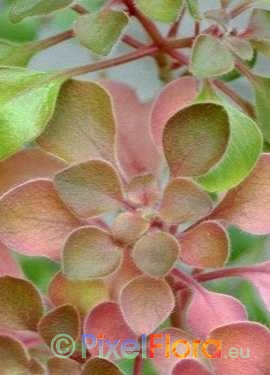 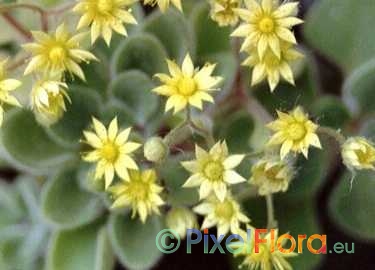 Some 10 endemic Aichryson taxa occur on the Canary islands and another
at least 6 taxa outside this archipelago. Aichryson usually share their habitat with either Aeonium or Greenovia species, yet in general they prefer more sheltered and humid places, as they either grow as fragile weeds or low subshrubs. They have numerus, rather large, usually bright yellow flowers and are as easy to grow as are Aeonium species. In winter they require a rather sunny spot inside at moderate, cool temperatures. If they become too large, plants can be cut back. Cuttings
will easily root within few days. These ornamental dwarf plants are excellent pot plants and will thrive in any partially shaded spot at cool temperatures, e.g. on a window sill. In our shop you will find the most complete selection of seeds from Aichryson species, which you will ever see throughout the world! Some 10 endemic Aichryson taxa occur on the Canary islands and another
at least 6 taxa outside this archipelago. Aichryson usually share their habitat with either Aeonium or Greenovia species, yet in general they prefer more sheltered and humid places, as they either grow as fragile weeds or low subshrubs. They have numerus, rather large, usually bright yellow flowers and are as easy to grow as are Aeonium species. In winter they require a rather sunny spot inside at moderate, cool temperatures. If they become too large, plants can be cut back. Cuttings
will easily root within few days. These ornamental dwarf plants are excellent pot plants and will thrive in any partially shaded spot at cool temperatures, e.g. on a window sill. In our shop you will find the most complete selection of seeds from Aichryson species, which you will ever see throughout the world!
The Genus Greenovia
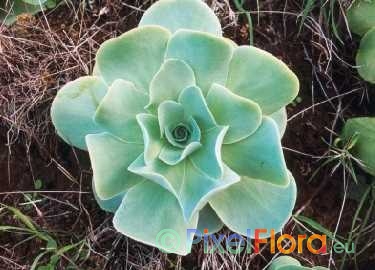 The genus Greenovia consists of only 4 taxa (Greenovia aizoon, Greenovia aurea, Greenovia diplocycla and Greenovia dodrentalis),
out of which 3 species occur on the island of Tenerife. Most of them grow in north-facing rock crevices in the "Barrancos" (typical deep-cut valleys, especially on the western islands and on Gran Canaria). Due to their dense rosettes and brilliant green, glaucous color of their leaves, these plants are locally called "rosas del monte" (mountain roses). All species (except Greenovia diplocycla) offset rather freely, whereas the mother-plant will slowly die down after flowering. Greenovia aizoon is one of the rarest of all endemic species on this archipelago and can be found in
very limited localities on Tenerife only. The genus Greenovia consists of only 4 taxa (Greenovia aizoon, Greenovia aurea, Greenovia diplocycla and Greenovia dodrentalis),
out of which 3 species occur on the island of Tenerife. Most of them grow in north-facing rock crevices in the "Barrancos" (typical deep-cut valleys, especially on the western islands and on Gran Canaria). Due to their dense rosettes and brilliant green, glaucous color of their leaves, these plants are locally called "rosas del monte" (mountain roses). All species (except Greenovia diplocycla) offset rather freely, whereas the mother-plant will slowly die down after flowering. Greenovia aizoon is one of the rarest of all endemic species on this archipelago and can be found in
very limited localities on Tenerife only.
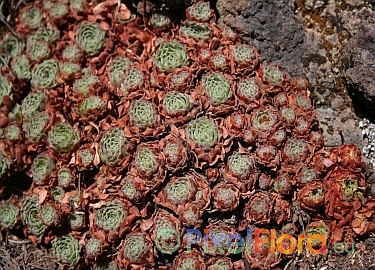 Greenovia dodrentalis used to have its main locality in the Barranco de Masca on Tenerife, yet due to excessive touristic activities (especially hiking and probably "incidentally" plant collection) its' populations have decreased significantly in recent years so that it has become threatened with extinction. All Greenovia species form perfect, very dense rosettes and a single large inflorescence of numerous yellow flowers before the mother plant will die down. They are highly
ornamental species due to their dense rosette of glaucous leaves which will close almost completely during summer, if plants are not watered. The outer leaves will then whither and turn orange-red or whitish-beige. As soon as temperatures will decrease in autumn in combination with a raise in air humidity, the dry-looking rosettes will restart their growth and completely unfold within few weeks. In our shop you will find seeds from all Greenovia species and even a new discovery, namely Greenovia diplocylca var. gigantea from La Gomera, which makes huge rosettes embedded in
paper-like whitish-beige dry leaves in summer - a superb new species! Greenovia dodrentalis used to have its main locality in the Barranco de Masca on Tenerife, yet due to excessive touristic activities (especially hiking and probably "incidentally" plant collection) its' populations have decreased significantly in recent years so that it has become threatened with extinction. All Greenovia species form perfect, very dense rosettes and a single large inflorescence of numerous yellow flowers before the mother plant will die down. They are highly
ornamental species due to their dense rosette of glaucous leaves which will close almost completely during summer, if plants are not watered. The outer leaves will then whither and turn orange-red or whitish-beige. As soon as temperatures will decrease in autumn in combination with a raise in air humidity, the dry-looking rosettes will restart their growth and completely unfold within few weeks. In our shop you will find seeds from all Greenovia species and even a new discovery, namely Greenovia diplocylca var. gigantea from La Gomera, which makes huge rosettes embedded in
paper-like whitish-beige dry leaves in summer - a superb new species!
Sowing and Cultivation
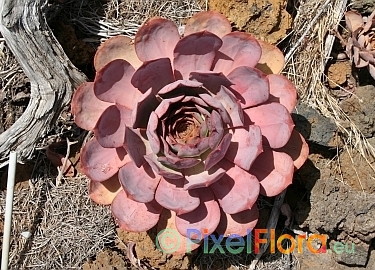 Sowing of Aeonium,
Aichryson, Greenovia and their relatives within the oprine family from the Canaries, Madeira and the Mediterranean region (e. g. several Sedum and Umbilicus species) is very easy. for most adopt very well to different cultivation conditions. All species can be virtually grown in any substrate, which should be very well draining and rather pH-neutral (~ pH 7). Use any soil which you would use for cacti or any other succulents, for example. In general
the substrate should be rather inorganic, i. e. it should consist of few parts of humus only. All smaller species, including all Greenovia as well as most Sedum species should be given some extra crushed lava, some grit sand or some pumice in order to enhance drainage. Aeonium cuneatum and other species from the semi-moist laurel forest (such as most Aichryson and all Umbilicus species) may be given some extra parts of humus (up to 50% vol.), e. g. some old, well-matured compost. Sowing of Aeonium,
Aichryson, Greenovia and their relatives within the oprine family from the Canaries, Madeira and the Mediterranean region (e. g. several Sedum and Umbilicus species) is very easy. for most adopt very well to different cultivation conditions. All species can be virtually grown in any substrate, which should be very well draining and rather pH-neutral (~ pH 7). Use any soil which you would use for cacti or any other succulents, for example. In general
the substrate should be rather inorganic, i. e. it should consist of few parts of humus only. All smaller species, including all Greenovia as well as most Sedum species should be given some extra crushed lava, some grit sand or some pumice in order to enhance drainage. Aeonium cuneatum and other species from the semi-moist laurel forest (such as most Aichryson and all Umbilicus species) may be given some extra parts of humus (up to 50% vol.), e. g. some old, well-matured compost.
Sow the dust-like seeds very thin and evenly on the
substrate's surface. Do not cover seeds with soil. It is recommendable to use only about one third of the seeds supplied per species for a first try. If too many seeds are sowed, within few days a "carpet" of seedlings will develop. Later these numerous seedlings will suppress each other in growth. You may want to store unused seeds in the original sealed package in a refrigerator (not in the freezer!!), where they will maintain an overall high viability for at least 5 years. Water sowing always from beneath in order not to shed the seeds from the surface and keep pots in a warm and partially shaded spot at between 15°C and 25°C. Temperatures above 25°C will inhibit germination for
seeds will enter a heat induced dormancy till they may eventually germinate with decreasing temperatures. Germination occurs quite fast and evenly within some 7 to 21 days. As soon as seedlings appear, place them into direct sunlight (during winter months), respectively into partial shade (during summer months) and never let dry out the soil completely.
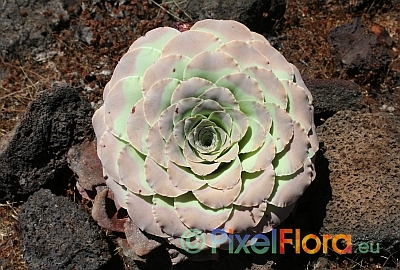 Many species in these genera will enter a more or less pronounced dormancy period during hot weather in summer months in Central Europe. With rising temperatures in early summer most plants will more or less close their rosettes and/or will lose most of their leaves in order to protect themselves from dissection
by reducing surfaces of assimilation and transpiration. However, plants in cultivation do much better if they are not "baked" in summer, as it usually happens in their natural habitats. Keep them always slightly moist, thus they will grow faster and will gain flowering size sooner. During winter all smaller species should be placed in a sunny and warm spot with slightly reduced watering. Under these conditions, some species might start to flower
towards the end of spring or in early summer already. Larger shrub-like and somewhat woody species, such as Aeonium manriqueorum, Aeonium ciliatum, Aeonium davidbramwellii, as well as the giant species such as Aeonium hierrense and Aeonium undulatum might be kept at cooler temperatures during winter as long as soil is kept almost completely dry. Under these conditions plants may shrink significantly and most likely they will
loose most of their leaves, so that only the compact center of the leaf rosette will survive. New leaves will soon emerge within few weeks in spring with rising temperatures and increased watering. Most species will hence develop their ornamental inflorescences. Many species in these genera will enter a more or less pronounced dormancy period during hot weather in summer months in Central Europe. With rising temperatures in early summer most plants will more or less close their rosettes and/or will lose most of their leaves in order to protect themselves from dissection
by reducing surfaces of assimilation and transpiration. However, plants in cultivation do much better if they are not "baked" in summer, as it usually happens in their natural habitats. Keep them always slightly moist, thus they will grow faster and will gain flowering size sooner. During winter all smaller species should be placed in a sunny and warm spot with slightly reduced watering. Under these conditions, some species might start to flower
towards the end of spring or in early summer already. Larger shrub-like and somewhat woody species, such as Aeonium manriqueorum, Aeonium ciliatum, Aeonium davidbramwellii, as well as the giant species such as Aeonium hierrense and Aeonium undulatum might be kept at cooler temperatures during winter as long as soil is kept almost completely dry. Under these conditions plants may shrink significantly and most likely they will
loose most of their leaves, so that only the compact center of the leaf rosette will survive. New leaves will soon emerge within few weeks in spring with rising temperatures and increased watering. Most species will hence develop their ornamental inflorescences.
For certain species with deviant horticultural requirements some additional instructions and information are given on the main page for these genera. Note: All offered seeds are from true-to-type plants and derive from artificially propagated plants.
[Download this document as PDF-file:  . Adobe Acrobat Reader for viewing PDF is available in English for free here.] . Adobe Acrobat Reader for viewing PDF is available in English for free here.]
All information on this page is presented without any guarantee.
|
 View Basket
 Recover Basket